
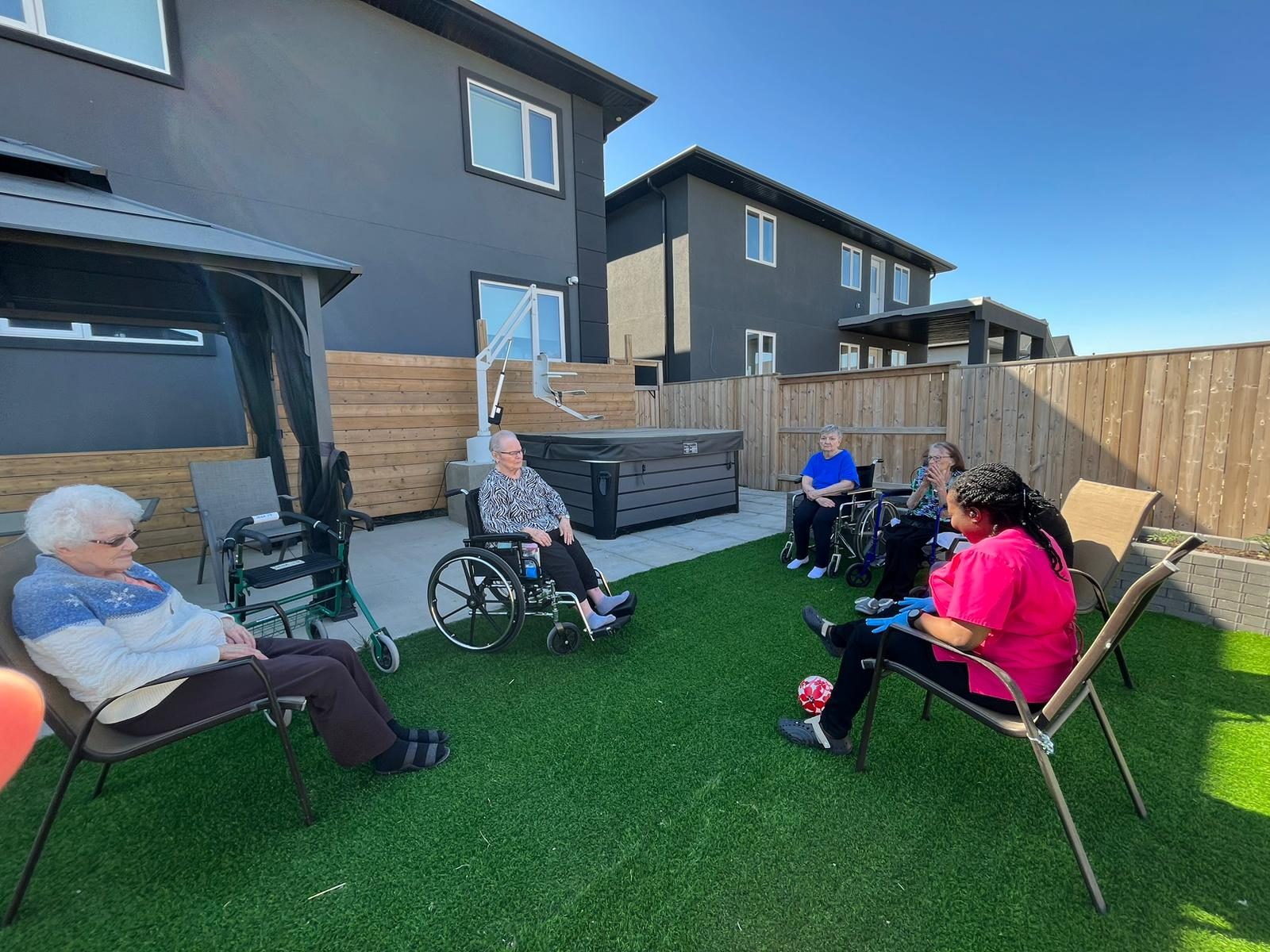
Few decisions weigh on a family the way this one does. Realising that a parent or a partner can no longer manage safely at home is rarely a single moment — it is a slow, worried conversation that builds over months, often carried by one son or daughter who isn’t sure where to begin. If that is where you are right now, you are in the right place, and you are not behind.
This guide is written by the people who run small personal care homes here in Saskatoon. We have sat at a lot of kitchen tables with families in exactly your position. What follows is the honest version — what a care home actually is, how to tell a good one from a polished one, what it costs, and what help exists — without the brochure language.
First, what a personal care home actually is
In Saskatchewan, a personal care home is a licensed residence where seniors who can no longer manage on their own receive help with daily life — meals, medication, bathing, dressing, and the simple comfort of company. Personal care homes are licensed and monitored by the provincial Ministry of Health under The Personal Care Homes Act, and most are small, privately operated businesses rather than government facilities.1
It helps to know what a personal care home is not. It is different from a special care home — the term Saskatchewan uses for government-run long-term care, which is built for people with the heaviest, most medically complex needs.2 A personal care home generally suits someone who needs steady day-to-day support but not hospital-level nursing. Many homes also care comfortably for residents with moderate or heavier needs, including memory loss — which is exactly the kind of question worth asking early.
Start with the care your family member needs — today and a year from now
Before you tour a single home, be honest with yourself and your family about how much help your loved one truly needs. Care needs tend to fall along a range: light support (meal preparation, housekeeping, reminders to take medication), moderate support (help with bathing, dressing, and moving safely), and heavier or complex needs (dementia, diabetes, recovery from a stroke).
Then ask the harder question: what about a year from now? Needs almost always grow. One of the kindest things you can do is ask every home you visit a direct question — what happens when my mum needs more care than she does today? Some homes are equipped to keep a resident as their needs increase; others will, at some point, ask the family to find a new placement. Knowing this in advance spares everyone a painful, rushed move later.
Visit in person — and trust your senses
No website, photo gallery, or price sheet can tell you what a home truly feels like. You have to walk in. And when you do, pay attention to what your senses tell you before you read a single brochure.
Does the home smell clean and fresh, or is there a heavy air freshener covering something? Is it calm, or is a television blaring to no one? Are residents up, dressed, and doing something — or parked in a hallway? Most telling of all: how do staff speak to residents? Listen for first names, warmth, eye contact, and an unhurried tone. You can teach a team a great many things; you cannot teach them to be kind.
Visit more than once, and at different times — a weekday afternoon, and again around a mealtime. If you can, stay and share a meal. Mealtimes reveal everything: the quality of the food, whether residents are helped patiently, and whether the room feels like a household or an institution.
Ask hard questions about staffing
Care is not a building. Care is people, and there is no polite way around asking about them directly. How many caregivers are on duty during the day, in the evening, and overnight? Is someone awake all night, or on call from a bed? Is there nursing oversight, and how often?
Ask about consistency, too. Do the same caregivers return day after day, so they come to know that your father takes his tea strong and gets anxious before dark? In a small home of, say, 15 residents, that kind of familiarity is the everyday norm. In a large facility it can be much harder to find. Bigger is not better — what matters is whether daily life feels personal.
Understand the true cost — and get it in writing
Personal care homes are private businesses, and each one sets its own fees. In Saskatchewan, monthly costs vary widely — roughly $1,500 to $5,000 — depending on the home, the room, and how much care a resident needs.3 A private room with an ensuite costs more than a shared one; heavier care costs more than light support.
The figure on the first page is rarely the whole story. Ask plainly what is included and what is billed on top: medication management, laundry, incontinence supplies, hairdressing, outings, or extra one-to-one hours. Then ask for the full fee schedule in writing. A home that is straightforward with you about money is usually straightforward about everything else. You can see how we approach this on our pricing page.
Know what financial help is available
Many Saskatchewan families never find out about help they may be entitled to. The province offers the Personal Care Home Benefit, a monthly payment for lower-income seniors living in a licensed personal care home.
In April 2025 the government increased it: the monthly income threshold rose to $3,500.4 In broad terms, if a senior is 65 or older, receives the Old Age Security pension, lives in a licensed personal care home, and has a monthly income below that threshold, the benefit can help close the gap between their income and the cost of care.5 It is worth applying even if you are not certain you qualify — the Personal Care Home Benefit office (1‑855‑544‑7242) can walk you through it.
Don’t wait for a crisis
If we could give families one piece of advice, it would be this: start looking before you have to. Good homes fill up. Across the country, seniors’ housing is close to full — national occupancy climbed back to roughly 91.5% in 2025, and with little new construction underway the market is only expected to tighten.6 The best small homes in Saskatoon often keep a waiting list.
The hardest moves we ever see are the rushed ones — a fall, a hospital stay, and suddenly a family has a single weekend to make a decision that deserves months.
Looking early, while there is no emergency, costs you nothing and changes everything. It lets you choose calmly, compare honestly, and bring your loved one somewhere you have already come to know and trust.
A short list of questions to take with you
Print this, or keep it on your phone. Ask every home the same things, so that you can compare them fairly:
- Is the home licensed under The Personal Care Homes Act?
- Who is awake and on duty overnight?
- What happens if my parent’s care needs increase over time?
- What exactly is included in the monthly fee — and what costs extra?
- May we visit again, unannounced, and stay for a meal?
- How are medications managed, and how do you handle a medical emergency?
- How is memory loss or dementia supported?
- What does an ordinary day here actually look like?
How Beacon House fits in
We run three small personal care homes in Saskatoon, each carrying its own name alongside ours. Kloppenburg Residences by Beacon House sits on a tree-lined street in Evergreen. Brighton Elm by Beacon House and Brighton Oak by Beacon House are sister homes a few doors apart in the Brighton neighbourhood. Each one is home to just 15 residents — small enough that every person is known by name, and every family is too. We built all three around everything written above.
We would always rather you came and saw for yourself than took our word for it. Walk through the door. Stay for a cup of tea. Ask us every hard question on the list above — especially the ones about staffing and cost. Book a visit whenever you are ready, and we will show you around.
Whatever you decide, and wherever your family lands, we hope this has made a heavy decision feel a little lighter.
Sources
The facts and figures in this guide are current as of May 2026 and drawn from the following sources:
- Personal Care Homes — Government of Saskatchewan.
- Special Care Homes — Government of Saskatchewan.
- Costs of Retirement in Saskatchewan — Comfort Life.
- Government Makes Personal Care Homes More Affordable for Seniors — Government of Saskatchewan, 25 April 2025.
- Personal Care Home Benefit — Government of Saskatchewan, Seniors Services.
- Canadian Seniors Housing Market Overview — Cushman & Wakefield, 2025.